
CSIDNet Working Group on Early Warning Systems in LMICs: Q3 Progress Update
Written by the EWS working group
The CSIDNet Working Group on Early Warning Systems (EWS) in LMICs fosters collaboration, peer learning and the practical application of existing climate-sensitive infectious disease models rather than developing another standalone tool. In the third quarter, the group moved from the model testing and dashboard prototyping reported in our Q2 update to consolidating this work into scientific manuscripts.
Progress Update
Five manuscripts are in progress. Their status, as reviewed at the group meeting of 26 September 2026, is as follows:
- One Health surveillance framework. The collaborative review announced in Q2 is close to submission; formatting, references and the cover letter remain.
- Multi-hazard early warning system and One Health suitability index. A consolidated draft is being finalized. The proposed index has not yet been validated.
- Multi-disease emerging disease atlas. A dashboard covering Africa, with a focus on West Africa, brings together outbreak records from the literature, risk drivers, distance to care and climate projections under Shared Socioeconomic Pathway (SSP) scenarios. A first draft is in preparation.
- VECTRI malaria modelling. Following the implementation reported in Q2, the model will be applied to Nigeria or Mali, or to several countries in a comparative study, subject to the availability of observed monthly malaria data.
- ARBOTHAI framework applied to Senegal. The dashboard now reports incidence per 1,000 inhabitants instead of case counts and shows higher transmission in southern Senegal.
The prototype dashboards supporting these manuscripts remain under active development:
- Emerging Disease Atlas for Africa.
- Aedes Habitat Suitability in Africa (monthly, 1975-2024).
- Dashboard EWS Malaria Senegal.
- Dengue Early Warning System (EWS) – Senegal.
- Senegal ARBOTHAI Malaria EWS Dashboard.
The group also welcomed three new members from Zimbabwe and Nigeria, set up a shared folder for all drafts, and agreed on a review cycle: two weeks for comments, finalization by the lead author, five days for final feedback, then submission.
After the quarter, on 27 and 28 October 2026, the Working Group took part in the 1st CSIDNet Francophone Africa Regional Convening in Yaoundé, held with the 4th PAMCA Scientific Conference on vector-borne diseases and climate change. On behalf of the Working Group, Dr Ibrahima Diouf presented the validation of the VECTRI malaria model in four countries: Senegal, Niger, Nigeria and Cameroon. Where monthly surveillance data allow (Senegal and northern Cameroon), VECTRI captures the seasonal timing of transmission well, with a lag of about one month on cases. For early warning, the model works best when combined with statistical models fed by surveillance data. The Cameroon dashboard prepared for this work is validated against regional data from the National Malaria Control Programme (2020-2024).
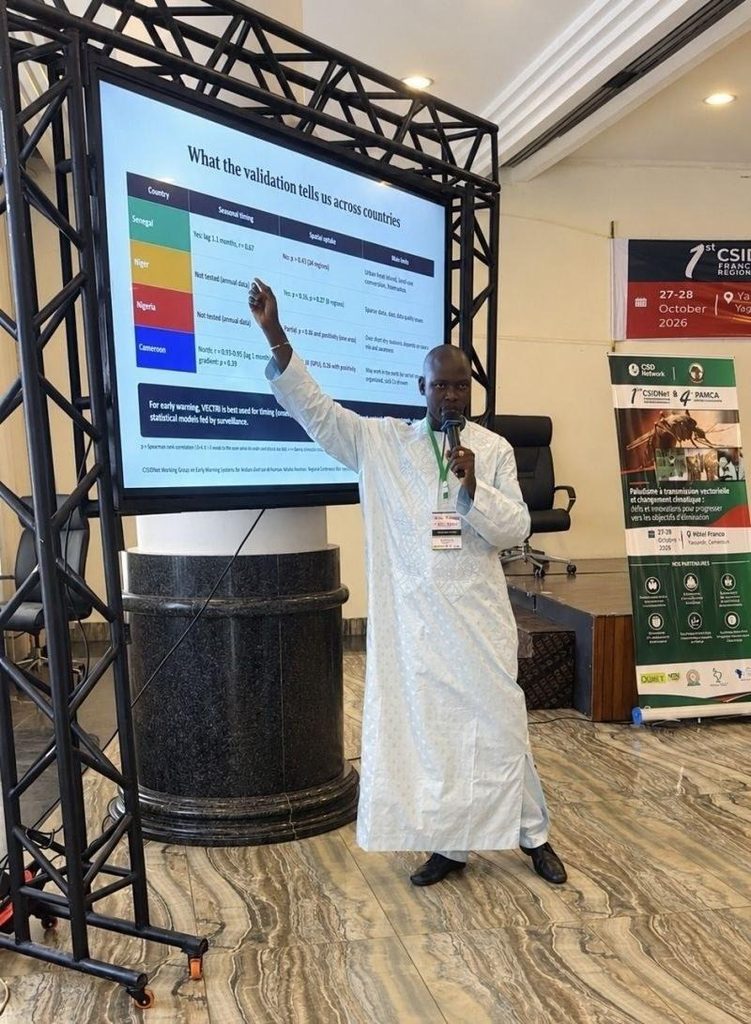
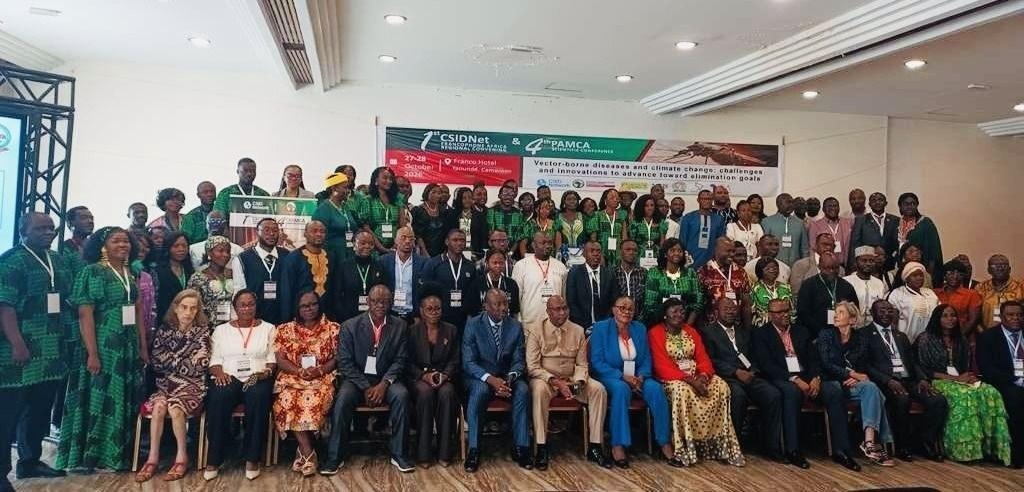
Presentation of the VECTRI validation results on behalf of the Working Group (left) and participants of the 1st CSIDNet Francophone Africa Regional Convening and 4th PAMCA Scientific Conference (right), Yaoundé, 27-28 October 2026.
Key Learnings
- Data. Validating a model in a new country requires observed monthly surveillance data; simulated outputs alone are not sufficient. Access to raw data remains the main bottleneck. The group therefore validates models only where observed surveillance data are available, as in Senegal with monthly data from the National Malaria Control Programme; outputs for countries without such data are presented as exploratory results only.
- Focus. With limited time, improving the manuscripts already in the pipeline is more valuable than starting new ones.
- Dashboards. Dashboards serve as pilot work: they produce figures for the manuscripts and make model outputs accessible to non-modellers.
- Publication costs. The group publication budget does not cover five papers, so alternative sources for article processing charges must be identified. The group will request the waivers available to authors from LMICs, give priority to journals with no or reduced charges and to institutional agreements, and post preprints so that results remain openly accessible.
How Others Can Get Involved
We invite the CSIDNet community to:
- Explore the dashboards and share feedback; contact details are available within each dashboard;
- Share observed monthly malaria or arbovirus data, in particular for Nigeria and Mali;
- Contribute to or review the manuscript of your choice, including machine learning approaches, by contacting the Working Group leads, Dr Ibrahima Diouf ([email protected]) and Mamadou D. Coulibaly (contact details on the Working Group page), who will share access to the drafts in the group’s shared folder;
- Provide general recommendations regarding the documents;
- Suggest suitable journals or institutional options for covering article processing charges.
Next Steps
Over the coming months, the Working Group will:
- Submit each manuscript as soon as it completes the agreed review cycle, with preprints where possible;
- Secure observed data for the VECTRI application and validate the One Health suitability index;
- Continue improving the dashboards based on community feedback;
- Hold follow-up meetings every two weeks.